
Graph
Image
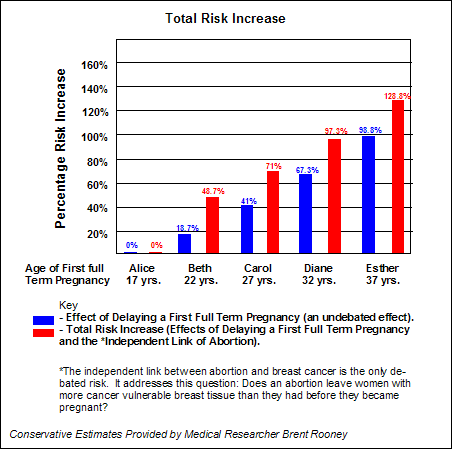
Scientists agree that the later a woman delays a first full term pregnancy, the greater her breast cancer risk is.
Scientists agree that the later a woman delays a first full term pregnancy, the greater her breast cancer risk is.
The Coalition on Abortion/Breast Cancer commented on a Danish study led by Christina Braüner entitled, “Induced abortion and breast cancer among parous women: A Danish cohort study.” 1
The Coalition on Abortion/Breast Cancer reports on a study published in the Indian Journal of Community Medicine (May, 2013) whose authors found a 6.38-fold greater risk of breast cancer among women with histories of induced abortion. 1 The study, led by Ramachandra Kamath, MD (Department of Public Health, Manipal University), found induced abortion was the most important risk factor.
“With only 94 cases and 94 controls, the study was way too small for a significant risk of the order of 1.5-fold to even show up,” explained Professor Joel Brind (Baruch College, City University of New York). “Yet induced abortion did show up as the strongest risk factor (and right on the border of statistical significance) because the risk increase was so high at 6.38-fold.”
The Coalition on Abortion/Breast Cancer notes an editorial by Editor Ed Furton, MA, Ph.D. in the December issue of a bioethics journal, Ethics and Medics. 1 Furton charged that a widely reported "review" of the abortion-breast cancer (ABC) studies published in the Lancet was seriously flawed for having omitted 15 studies reporting risk elevations "for no good reasons" and using an "inappropriate control group."
The Coalition on Abortion/Breast Cancer vigorously applauds the breast cancer organization, Susan G. Komen for the Cure, for discontinuing its grants to Planned Parenthood (PP).
"Komen's decision is a giant step in the right direction to protect women's lives," said Karen Malec, president of the Coalition on Abortion/Breast Cancer. On the other hand, our group will remain as Komen's critic as long as it continues to work against its own mission to eradicate breast cancer. Personally, I will not donate to Komen while it is still cooperating in the cover-up of the abortion-breast cancer link and downplaying the risk of using oral contraceptives (OCs).
The work done by Karen Malec was an effort to protect the health and save the lives of women by educating and providing information on abortion as a risk factor for breast cancer.
We are volunteers whose work depends entirely on the generosity of good people like you.